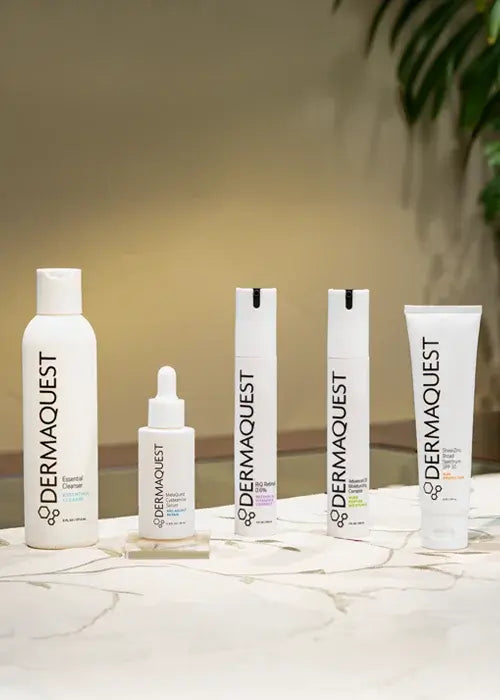



A client sits down for their post-treatment consultation and asks a question you've heard before: Does their mineral sunscreen actually work differently than the one they bought at their local store? It's a fair question一and how you answer it shapes their habits, trust, and the results you're working together to maintain.
Ingredient literacy makes that conversation sharper. This guide covers how chemical and mineral sunscreen filters work, where each performs best, and how to evaluate formulations beyond SPF.
How Sunscreen Filters Work
Sunscreen actives fall into two categories: mineral (physical) filters and chemical (organic) filters. Both provide UV protection, but through fundamentally different mechanisms.
Mineral filters sit on the skin's surface. When UV radiation reaches the skin, these ingredients reflect and scatter the rays outward rather than permitting them to penetrate. The two mineral filters approved for use in the U.S. are zinc oxide and titanium dioxide. They work immediately upon application and are not absorbed into the skin.
Specifically, zinc oxide covers the full UV spectrum. Titanium dioxide offers strong UVB and short-wave UVA2 protection but more limited UVA1 coverage—making zinc oxide the more complete single-filter option, and dual-mineral formulas a common approach to broader protection.
Chemical filters absorb UV radiation into the skin and release it as heat. Because individual chemical filters typically protect within specific wavelength ranges, chemical formulas can combine multiple actives to achieve broad-spectrum coverage.
They can offer lighter textures and no white cast. However, they can also irritate sensitive skin types and are generally not recommended for post-procedure use due to their tendency to generate heat.
In the U.S., the FDA regulates sunscreens as over-the-counter drug products, with permitted active ingredients identified in its sunscreen deemed final order, including chemical filters such as avobenzone, homosalate, octisalate, octocrylene, octinoxate, oxybenzone, and ensulizole.
Mineral vs. Chemical Sunscreen Filters:
A Clinical Comparison
|
Zinc Oxide |
Titanium Dioxide |
Chemical Filters |
|
|
Mechanism |
Reflects and scatters UV at the surface |
Reflects and scatters UV at the surface |
Absorbs UV, releases as heat |
|
Broad-Spectrum Coverage |
Full UVA1, UVA2, and UVB |
Strong UVB and UVA2; limited UVA1 |
Depends on actives; multi-filter combinations required |
|
Photostability |
Inherently stable |
Inherently stable |
Varies; some actives require stabilizers |
|
Post-Procedure Suitability |
Ideal |
Suitable |
Not recommended |
|
Sensitive Skin Tolerance |
Excellent |
Good |
Variable; can irritate reactive skin |
|
Texture |
Can leave white cast; oil-free formulas available |
Lighter than zinc oxide alone |
Lightweight; sheer finish |
|
Onset of Protection |
Immediate |
Immediate |
Requires absorption time |
|
Blue Light & Infrared Protection |
Not inherent; requires additional actives such as InfraGuard™ and Elix-IR™ |
Not inherent; requires additional actives such as InfraGuard™ and Elix-IR™ |
Not inherent; requires additional actives such as InfraGuard™ and Elix-IR™ |
Zinc Oxide: The Benchmark Mineral Filter
Zinc oxide delivers the most complete UV coverage of any single filter, covering UVA1, UVA2, and UVB wavelengths at adequate concentrations. Beyond UV protection, it offers:
- Anti-inflammatory and antimicrobial properties
- Support for wound healing and barrier recovery
- Calming of redness and irritation
- Regulation of excess sebum
- Well-established tolerance in sensitive, acne-prone, and post-procedure skin
Concentration matters clinically. Higher zinc oxide percentages provide broader UVA1 coverage, the wavelength range most implicated in deep-tissue damage and persistent pigmentation. For clients managing melasma or post-inflammatory hyperpigmentation, consistent SPF with adequate UVA1 protection is strongly recommended as a treatment prerequisite.
DermaQuest’s SheerZinc Broad Spectrum SPF 30 is an oil-free formulation using 18.6% zinc oxide as its sole active, supported by THD Ascorbate (BV-OSC) for antioxidant defense, Arabidopsis Thaliana Extract for DNA repair support, and InfraGuard™ and Elix-IR™ for infrared and blue light protection.
Products Mentioned in Blog

SheerZinc Broad Spectrum SPF 30

SunArmor Broad Spectrum SPF 50
Titanium Dioxide: A Complementary Filter
Titanium dioxide creates a physical barrier that reflects and scatters incoming UV rays. Its coverage profile includes:
- Strong UVB and short-wave UVA2 protection
- More limited coverage in the longer UVA1 range compared to zinc oxide
- Most effective as part of a dual-filter formula, not as a standalone active
When paired with zinc oxide, titanium dioxide contributes meaningful UVB coverage. It supports a lighter texture without sacrificing protection. DermaQuest's SunArmor Broad Spectrum SPF 50, also oil-free, combines zinc oxide 8.6% and titanium dioxide 6.5% in a high-SPF formula suited for normal to dry skin, with Cyclotetrapeptide-24, Matrixyl 3000 (Palmitoyl Tetrapeptide-7), InfraGuard™, and Elix-IR™ to address photodamage and multi-spectrum environmental stressors.
Chemical Filters: Strengths and Practical Limitations
Chemical filters are not a lesser option; they're a different clinical tool. Their lighter textures and sheer finish can help compliance in clients who resist mineral formulas. The key considerations:
- Wavelength coverage: Most filters target a specific UV range. Avobenzone is among the few covering UVA1; actives such as octinoxate and octocrylene are primarily UVB-focused. Multi-filter combinations are required for true broad-spectrum coverage.
- Photostability: Some filters, particularly avobenzone, can degrade under UV exposure without stabilizing agents, which can reduce real-world efficacy.
- Heat generation: Chemical filters convert UV energy to heat. For post-procedure skin that is already inflamed, this is a meaningful contraindication.
- Sensitive skin tolerance: Chemical filters can also irritate reactive skin, compromised skin barriers, and rosacea-prone clients. Mineral filters are the more predictable choice for these cases.
- Compliance advantage: For clients without sensitivity concerns, lighter chemical textures can improve daily use.
Evaluating Formulations Beyond SPF
The SPF number on a product label measures UVB protection under controlled testing conditions. It doesn't reflect UVA depth, photostability, or protection from sources outside the UV spectrum.
For professionals building clinical protocols, the full formulation determines real-world value. Here's what to look for:
Antioxidant Support
UV exposure generates reactive oxygen species (ROS) that drive oxidative stress, even with proper SPF protection. Look for:
- THD Ascorbate (BV-OSC): A stable, oil-soluble vitamin C that penetrates the lipid barrier to neutralize oxidative stress and support collagen integrity without irritation risk
- Tocopherol (Vitamin E): Reinforces antioxidant defense and supports the lipid barrier
Multi-Spectrum Defense
Beyond UV, blue light and infrared radiation contribute meaningfully to cumulative damage:
- Blue light penetrates the epidermis and upper dermis, increasing oxidative stress, disrupting barrier function, and stimulating melanocyte activity, contributing to premature aging and persistent hyperpigmentation
- Infrared radiation penetrates deeper into the dermis, triggering inflammation, increasing reactive oxygen species, and activating matrix metalloproteinases (MMPs) that accelerate collagen and elastin breakdown
InfraGuard™, comprised of organic sunflower sprouts and tannin-rich tara tree extracts, defends against infrared, blue light, and environmental pollution by inhibiting collagen breakdown and supporting skin repair.
Elix-IR™ is a botanical that preserves collagen and elastin integrity within the extracellular matrix against light-induced cellular stress.
For clients with screen exposure, urban environments, or active pigmentation concerns, these additions represent a meaningful extension of daily protection.
Products Mentioned in Blog

3D Tinted Moisturizing Broad Spectrum SPF 30
This powerful anti-aging tinted SPF expertly blends peptides with hydrating ingredients and broad-spectrum UV filters to provide essential moisture and UV protection while improving the visible signs of aging. While soothing botanical extracts, peptides, and antioxidants work together to restore firmness and glow.Corrective Actives
Sun protection formulas that layer corrective actives enable daily SPF to serve a dual function.
The 3D Tinted Moisturizing Broad Spectrum SPF 30 includes zinc oxide 18.6% alongside Acetyl Hexapeptide-8 (Argireline), which helps reduce the appearance of dynamic lines by inhibiting muscle contractions, and Leontopodium Alpinum Meristem Cell Culture (edelweiss stem cells) to support elasticity and dermal density. For clients with combined anti-aging and pigmentation goals, a tinted SPF with this profile earns its place as a multi-functional step.
Applying This in Practice
The clinical question is not mineral vs. chemical as a binary一it's which combination of actives, concentrations, and supporting ingredients best serves this client's skin type, treatment context, and daily habits:
- Post-procedure and reactive skin: Zinc oxide-only formula, immediate onset, no heat generation
- Active pigmentation treatment: High zinc oxide concentration, UVA1 coverage, blue light defense
- Normal to dry skin with anti-aging goals: Dual-filter or higher-SPF mineral formula with peptide and antioxidant support
- Compliance-resistant clients without sensitivity concerns: Chemical filters may improve daily adherence一a worn sunscreen outperforms an unused one
In a barrier-first approach, the Protect step within the DermaQuest Skin Health System™ is not a passive final layer. It defends skin barrier health, collagen investment, and targeted results established through earlier steps. Consistent broad-spectrum SPF preserves the transformation professional treatments work to create.
Partner With DermaQuest
Building a sun protection protocol your clients trust starts with the right formulations—and the right partner. DermaQuest supports professionals with clinical education, business development resources, and a complete skin health system designed to deliver results at every step. Whether you're establishing a new protocol or refining an existing one, the partnership extends beyond the product.
Ready to elevate your practice? Become a DermaQuest partner and get access to the education, support, and formulations your clients deserve.
Frequently Asked Questions
Elevate Your Sun Protection Protocol With DermaQuest
Your clients are looking for sun protection guidance they can trust. As a DermaQuest professional, you're positioned to provide it, backed by clinical formulations, education, and a partnership built around skin health outcomes. Become a DermaQuest partner to access the tools, support, and product portfolio your practice needs.